
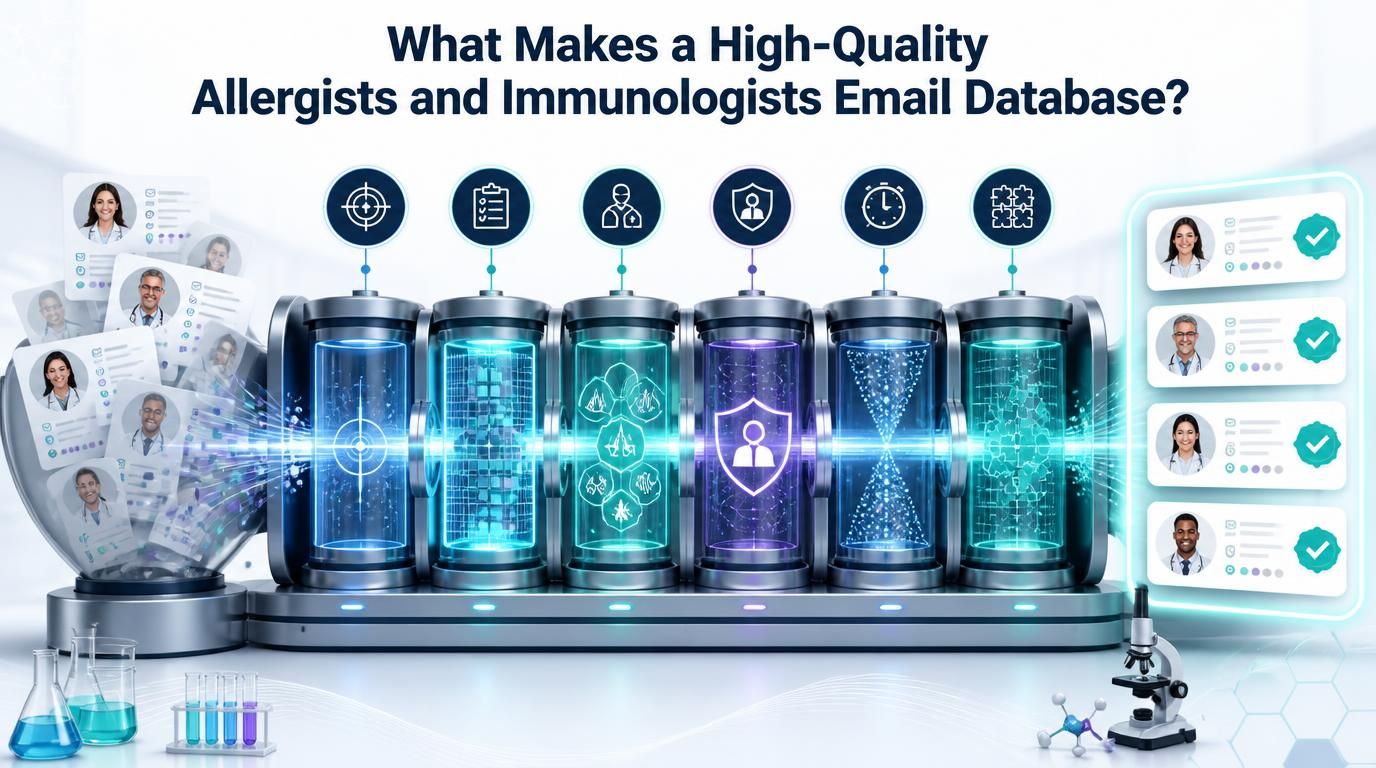
Effective healthcare marketing depends heavily on the quality and relevance of the audience being reached. An Allergists and Immunologists Email List can provide marketers with a focused way to identify professionals working in allergy and immunology, but the value of such a database depends on the accuracy, completeness, relevance, and usability of its information. A large collection of contacts is not necessarily a useful one if records are outdated, duplicated, incomplete, or poorly categorized.
A high-quality professional email database should help businesses understand who their contacts are, where they work, what roles they hold, and which audience segments may be relevant to particular campaigns. For organizations offering medical technologies, pharmaceutical products, diagnostic solutions, healthcare software, professional services, educational resources, or other B2B healthcare offerings, reliable data can provide a stronger foundation for targeted communication.
The most effective database strategies focus on data quality rather than contact volume alone. When professional information is maintained carefully and organized into meaningful categories, marketers can build more relevant campaigns while making audience management and performance measurement easier.
What Is an Allergists and Immunologists Email Database?
An allergists and immunologists email database is a structured collection of professional contact records associated with specialists working in allergy and immunology.
Depending on the source and intended use, individual records may contain information such as:
- Professional name
- Business email address
- Job title
- Organization name
- Practice type
- Location
- Specialty
- Professional role
- Organization size
- Areas of interest
- Customer or prospect status
- Engagement information
The exact fields can vary, but the purpose is generally to provide marketers with useful professional context.
A database should not be evaluated simply by counting how many records it contains. Quality depends on whether those records are relevant, accurate, current, and sufficiently detailed for the intended marketing strategy.
Why Database Quality Matters
Poor-quality contact information can affect several areas of a marketing program.
Incorrect email addresses may lead to delivery problems. Outdated job titles can result in inappropriate messaging. Duplicate records can distort campaign reporting. Missing professional information can make meaningful segmentation more difficult.
A well-maintained database can help marketers:
- Identify relevant professional audiences
- Develop targeted campaigns
- Create meaningful segments
- Personalize communications
- Support lead-nurturing programs
- Coordinate marketing and sales
- Promote educational content
- Analyze campaign performance
- Manage account-based campaigns
- Reduce unnecessary outreach
The objective is not to guarantee higher conversions. Instead, quality data gives marketing teams a more reliable foundation for making targeting and communication decisions.
1. Accurate Contact Information
Accuracy is a fundamental characteristic of a high-quality professional database.
Contact records should contain information that is reasonably current and appropriate for professional communication. Allergists and immunologists may change organizations, positions, locations, or professional responsibilities, making ongoing validation important.
Useful information can include:
- Correct professional name
- Current organization
- Current job title
- Valid business email
- Accurate location
- Relevant practice information
A database should have processes for identifying records that may have become outdated.
Regular maintenance can help reduce the number of inactive or incorrect records and improve the overall reliability of the database.
2. Relevant Professional Details
An email address alone provides limited marketing insight.
Professional details help marketers understand the context surrounding each contact.
Useful fields can include:
- Specialty
- Job function
- Professional seniority
- Organization type
- Department
- Practice setting
- Geographic market
These details allow businesses to create more focused audience groups.
For example, a medical technology company may communicate differently with a clinical allergist than with a department director or practice owner. Professional context helps marketers make those distinctions.
3. Clear Specialty Classification
Allergy and immunology encompasses several areas of professional interest.
Where reliable information is available, contacts may be categorized according to relevant areas such as:
- Allergy care
- Immunology
- Pediatric allergy
- Asthma-related care
- Food allergy
- Environmental allergy
- Drug allergy
- Immunologic disorders
- Clinical research
- Diagnostic services
Specialty classification can help businesses identify audiences that may be more relevant to particular educational or commercial campaigns.
For example, content related to pediatric allergy may be more appropriate for professionals whose work involves children than for an audience with a different professional focus.
Why Specialty Classification Is Valuable
Without specialty information, marketers may have to send broad messages to an entire audience.
With reliable classification, campaigns can be more focused.
This can support:
- Topic-specific newsletters
- Educational campaigns
- Product announcements
- Event invitations
- Research content
- Professional resources
The key is to use only information that can be supported by reliable data.
4. Current Job Titles
Job titles provide another important layer of professional context.
A database may include professionals such as:
- Allergist
- Immunologist
- Allergy and Immunology Specialist
- Clinical Specialist
- Medical Director
- Department Head
- Practice Owner
- Researcher
- Clinical Educator
Different roles can involve different responsibilities.
A practice owner may participate in purchasing decisions, while a clinical professional may be more focused on practical applications and patient-care workflows.
Job-title segmentation can therefore help marketers tailor the emphasis of their campaigns.
5. Organization Information
A professional contact becomes more useful when the database also identifies the organization where that person works.
Relevant organization information can include:
- Organization name
- Organization type
- Department
- Number of locations
- Healthcare system affiliation
- Geographic coverage
- Organization size
This information can support both individual-level and account-level marketing.
For example, a business selling enterprise healthcare technology may prioritize larger organizations, while a provider of practice-management services may focus on independent practices.
6. Accurate Geographic Information
Location is an important factor in many B2B healthcare campaigns.
Contacts can potentially be organized by:
- Country
- State
- Province
- City
- Metropolitan area
- Postal region
- Sales territory
Geographic segmentation can support regional marketing initiatives.
For example, businesses hosting conferences, workshops, or professional events can identify audiences within relevant markets.
Location information can also help sales teams organize territories and prioritize accounts.
However, geographic fields should be regularly reviewed because professionals may relocate or change organizations.
7. Practice Setting Information
Allergists and immunologists can work in different professional environments.
These may include:
- Hospitals
- Private practices
- Specialty clinics
- Academic medical centers
- Research institutions
- Outpatient facilities
- Healthcare networks
- Community healthcare organizations
Practice setting can influence professional priorities.
A hospital-based specialist may work within a larger clinical and administrative structure, while an independent practitioner may have greater involvement in operational or purchasing decisions.
Marketing messages can be adjusted accordingly.
8. Decision-Making Information
A high-quality database can be particularly useful when it helps marketers identify professional roles that may participate in business decisions.
Potential decision-related roles include:
- Practice owners
- Medical directors
- Department leaders
- Clinical directors
- Procurement-related professionals
- Technology decision-makers
- Senior clinical professionals
However, marketers should avoid assuming that a job title automatically means someone controls purchasing.
Instead, role information should be used as one indicator within a broader targeting strategy.
9. Business Email Addresses
For professional B2B marketing, business email addresses are generally more appropriate than personal contact information.
A well-structured database should clearly distinguish professional contact information from other types of data where possible.
Business email information can help companies communicate in a professional context while supporting appropriate marketing practices.
Organizations should also ensure that their email campaigns comply with applicable laws, regulations, platform rules, and communication preferences.
10. Email Verification
Email verification is another important part of database maintenance.
Professional email addresses can become inactive when people change jobs, leave organizations, or stop using specific accounts.
Verification processes can help identify potential issues such as:
- Invalid addresses
- Inactive domains
- Incorrect formatting
- Duplicate addresses
- Undeliverable contacts
Verification does not make a database permanently accurate. It is an ongoing quality-control process.
11. Low Duplicate Rates
Duplicate records can create several marketing problems.
The same professional might appear multiple times because of differences in:
- Name spelling
- Organization formatting
- Job titles
- Email addresses
- Location fields
Duplicate records may result in repeated messages and inaccurate campaign reporting.
A high-quality database should have processes for identifying and consolidating duplicate entries.
This is particularly important when information is collected from multiple sources.
12. Complete Professional Profiles
Accuracy and completeness are related but different concepts.
A contact record can be accurate while still lacking important information.
For example, a record might have a valid email address but no organization, job title, or location.
Depending on the campaign, useful profile fields may include:
- Name
- Professional role
- Organization
- Specialty
- Location
- Practice type
- Business email
- Relevant interests
Complete records provide marketers with more options for segmentation and personalization.
13. Segmentation-Ready Structure
A database becomes significantly more useful when it can easily support segmentation.
Marketers may want to divide contacts based on:
- Location
- Specialty
- Professional role
- Practice setting
- Organization size
- Product interest
- Engagement
- Buyer journey
- Customer status
Consistent fields make these categories easier to create.
For example, if organization type is stored consistently, marketers can quickly identify contacts working in hospitals versus independent practices.
Poorly standardized information can make segmentation much more difficult.
14. Consistent Data Formatting
Data consistency is often overlooked.
Imagine that the same practice type appears in a database as:
- Private Practice
- Private practice
- Independent Practice
- Private Clinic
- Pvt Practice
These categories may represent similar environments but can create challenges when filtering or reporting.
Standardized values make databases easier to manage.
Consistency should be maintained across fields such as:
- Job title
- Organization type
- Geographic region
- Specialty
- Customer status
- Industry category
15. Relevant Engagement Data
Engagement information can add another dimension to a professional database.
Examples include:
- Email clicks
- Resource downloads
- Webinar registrations
- Event participation
- Website interactions
- Previous inquiries
- Campaign responses
This information can help marketers understand how contacts interact with their content.
For instance, professionals who regularly engage with educational resources may be suitable for additional educational campaigns.
Those who have become inactive may require a different communication strategy.
16. Customer and Prospect Classification
Not every contact should receive the same type of communication.
A database can distinguish between:
- New prospects
- Active prospects
- Qualified leads
- Existing customers
- Former customers
- Partners
- Event contacts
This classification can help marketing teams build more appropriate campaigns.
An existing customer may need product updates or educational resources, while a new prospect may need introductory information.
17. Communication Preferences
A professional database should appropriately manage communication preferences and opt-out information.
Important fields can include:
- Unsubscribe status
- Suppression status
- Marketing preferences
- Communication history
- Applicable consent information
When recipients opt out of marketing communication, those requests should be respected and reflected in the relevant systems.
Good preference management supports responsible marketing and helps organizations avoid unnecessary communication.
18. Transparent Data Sources
Understanding where contact information comes from is an important part of evaluating database quality.
Potential sources can include:
- Professional directories
- Public business information
- Organization websites
- Professional associations
- Registration information
- Customer-provided information
- Permission-based forms
- Other legitimate business sources
Businesses should evaluate whether their data sources are appropriate for their intended use.
Transparency also makes it easier to establish internal data-management procedures.
19. Regular Database Maintenance
A database should not remain unchanged after it is created.
Professional information changes over time.
An allergist or immunologist may:
- Move to a new practice
- Change job titles
- Join another healthcare organization
- Relocate
- Change responsibilities
- Leave a professional position
Regular updates help identify these changes.
Maintenance activities may include:
- Contact verification
- Duplicate removal
- Role updates
- Organization updates
- Email validation
- Inactive-record review
20. Strong Data Security
Professional contact information should be handled carefully.
Businesses should implement appropriate security practices for storing, accessing, and transferring database information.
Potential safeguards include:
- Controlled user access
- Authentication
- Secure storage
- Permission management
- Data-retention policies
- Periodic security reviews
Security becomes particularly important when databases are shared across marketing, sales, CRM, and analytics platforms.
21. CRM Integration
Integration with a CRM can improve how marketing and sales teams manage professional data.
A CRM can help organize:
- Contact details
- Account information
- Lead stages
- Sales ownership
- Campaign activity
- Customer history
- Communication records
When database fields are standardized, information can be transferred more easily between systems.
CRM integration can also help reduce data silos between marketing and sales teams.
22. Useful Firmographic Information
Firmographic information describes the characteristics of the organization associated with a contact.
Examples include:
- Organization size
- Number of locations
- Organization type
- Healthcare network affiliation
- Geographic market
- Service category
This information can help companies develop account-based campaigns.
For example, a healthcare software provider might prioritize larger organizations with multiple locations, while a smaller service provider may focus on independent practices.
23. Behavioral Information
Behavioral data describes how contacts interact with marketing content.
Examples include:
- Content downloads
- Email engagement
- Event registrations
- Website activity
- Webinar participation
- Previous responses
Behavioral information can help marketers identify areas of interest.
However, organizations should use tracking and behavioral data responsibly and in accordance with applicable privacy requirements.
24. Database Scalability
A quality database should be able to support changing business requirements.
As a company expands its products, services, or geographic markets, its database may need additional categories.
A scalable structure can accommodate:
- New specialties
- New locations
- New product categories
- Additional buyer stages
- New account classifications
- New engagement indicators
Scalability can reduce the need for major database restructuring as marketing programs grow.
25. Actionable Information
A database does not become better simply because it contains more fields.
The most valuable information is information that helps marketers make decisions.
For example, if location, professional role, practice setting, and engagement influence campaign strategy, these fields may be particularly useful.
Marketers should periodically evaluate whether each database field has a clear purpose.
How to Evaluate an Allergists and Immunologists Database
Before selecting or using a database, marketers can evaluate several areas.
Accuracy
Are contact and professional details reasonably current?
Relevance
Do the records actually match the intended audience?
Completeness
Are important professional and organizational fields available?
Segmentation
Can contacts be grouped according to meaningful characteristics?
Verification
Are email addresses and other important fields regularly checked?
Duplication
Are duplicate records identified and managed?
Preferences
Are unsubscribe requests and communication preferences properly maintained?
Integration
Can the information work effectively with existing CRM and marketing systems?
Security
Are appropriate controls used to protect the data?
These factors provide a more useful assessment than simply looking at the number of records.
Questions to Ask a Database Provider
Businesses considering a professional contact database can ask:
- How often is the data updated?
- How are email addresses verified?
- What professional fields are included?
- Can contacts be segmented?
- How are duplicates identified?
- How are outdated records handled?
- What organization information is available?
- Are business email addresses clearly identified?
- How are communication preferences managed?
- Can the database integrate with common CRM platforms?
These questions can help businesses understand the practical quality of the data before incorporating it into their marketing processes.
Database Quality vs. Database Size
A large database may look impressive, but volume alone does not determine usefulness.
Consider two databases.
The first contains a very large number of records but includes outdated emails, duplicates, incomplete profiles, and limited professional information.
The second contains fewer records but provides accurate professional roles, organizations, locations, specialties, and segmentation fields.
For a targeted B2B campaign, the second database may offer greater practical value.
The objective should therefore be relevant and reliable data, rather than maximum contact volume.
How a Quality Database Supports Marketing
A strong database can influence multiple parts of a marketing strategy.
Audience Targeting
Marketers can identify professionals who fit a campaign's requirements.
Segmentation
Contacts can be grouped according to professional and organizational characteristics.
Personalization
Relevant information can help marketers adjust content and messaging.
Lead Nurturing
Buyer-stage and engagement information can support more structured follow-up.
Sales Alignment
Sales teams can receive more useful context about accounts and prospects.
Campaign Measurement
Performance can be evaluated across different audience segments.
These benefits depend on the quality of the data and how effectively it is incorporated into the marketing workflow.
Building a Long-Term Database Quality Program
Maintaining a professional database should be treated as an ongoing process.
A practical program can include:
- Establishing data standards
- Validating contact information
- Removing duplicates
- Updating professional roles
- Reviewing organization information
- Tracking engagement
- Managing communication preferences
- Synchronizing CRM records
- Monitoring database performance
- Conducting periodic audits
This approach can help keep information useful as the market and professional landscape change.
Common Mistakes to Avoid
Several database practices can reduce campaign effectiveness.
Focusing Only on Contact Volume
More records do not automatically mean better targeting.
Ignoring Data Age
Old information can quickly become less useful.
Sending Identical Messages to Everyone
Different professional groups may have different interests.
Neglecting Duplicate Management
Duplicates can create unnecessary communication and inaccurate reporting.
Using Inconsistent Categories
Poorly standardized fields can make segmentation difficult.
Ignoring Communication Preferences
Opt-out requests should be handled appropriately.
Collecting Unnecessary Information
Every database field should have a legitimate business purpose.
The Role of Segmentation in Database Quality
Segmentation and database quality are closely connected.
A database may contain accurate email addresses, but without professional context, marketers may still struggle to create useful audience groups.
A stronger database structure allows marketers to combine criteria such as:
Specialty + Location + Practice Setting + Professional Role + Engagement
This creates an audience that is more clearly defined than a general list of healthcare professionals.
The goal should be to use a manageable number of meaningful segments rather than creating excessively narrow categories.
Future Trends in Professional Healthcare Databases
Healthcare marketing databases are likely to become increasingly data-driven.
Modern marketing platforms can combine professional information with behavioral and organizational data. Automation may help identify engagement changes, while analytics can provide deeper insight into audience patterns.
Predictive tools may also help marketers prioritize contacts according to defined business criteria.
Despite these technological developments, fundamental data-quality principles will remain important.
Accuracy, relevance, privacy, security, transparency, and responsible communication will continue to form the foundation of effective database management.
Practical Checklist
Before using an allergists and immunologists database, marketers can review the following checklist:
- Accurate professional names
- Valid business email addresses
- Current job titles
- Relevant specialty information
- Current organization details
- Practice-setting information
- Geographic data
- Organization characteristics
- Decision-making indicators
- Segmentation-ready fields
- Consistent data formatting
- Duplicate management
- Email verification
- Regular database updates
- Engagement information
- Customer-status classification
- Communication preferences
- Transparent data sources
- Appropriate security controls
- CRM compatibility
- Actionable information
Conclusion
A high-quality professional email database is built on accuracy, relevance, completeness, organization, and ongoing maintenance rather than contact volume alone. For businesses marketing to allergy and immunology professionals, reliable information can make it easier to identify relevant audiences, develop meaningful segments, personalize communication, and coordinate marketing and sales activities.
A strong database should provide useful professional and organizational context while supporting responsible communication practices. Regular verification, duplicate management, data standardization, security, and preference management can help maintain its usefulness over time.
Ultimately, the value of an Allergists and Immunologists Mailing List depends on how accurately it represents the intended professional audience and how effectively marketers use the information. When quality data is combined with thoughtful segmentation and relevant content, businesses can build a more structured foundation for targeted healthcare marketing.