
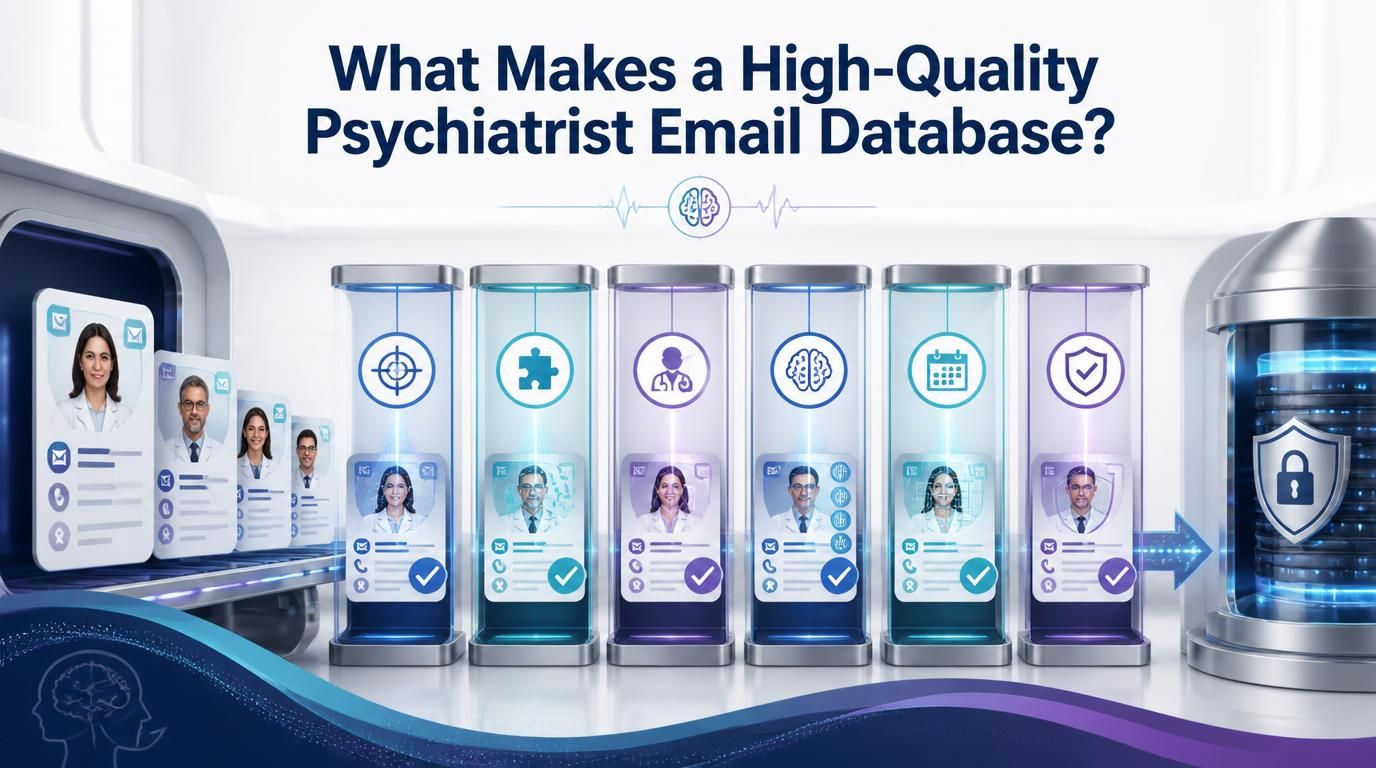
A Psychiatrist Email List can give businesses a structured way to reach relevant mental healthcare professionals for B2B marketing, educational outreach, and industry communication. However, the usefulness of such a resource depends less on the number of contacts and more on the quality of the information behind each record.
A high-quality psychiatrist email database should provide accurate, current, relevant, and well-organized professional information. When data is outdated, duplicated, incomplete, or poorly classified, even a large database can become difficult to use effectively.
For organizations serving behavioral healthcare, healthcare technology, pharmaceuticals, medical services, professional education, publishing, and other related industries, reliable professional data can support more focused audience selection. It can also help marketers develop communication that aligns more closely with the roles and organizational environments of their intended audiences.
This article examines the major characteristics that define a high-quality psychiatrist email database and explains what businesses should consider when evaluating one.
What Is a Psychiatrist Email Database?
A psychiatrist email database is a structured collection of professional information relating to psychiatrists and, depending on the database's scope, other relevant behavioral healthcare professionals.
Typical fields may include:
- Professional name
- Job title
- Business email address
- Practice or organization name
- Specialty or professional focus
- Practice setting
- Geographic location
- Organization size
- Business phone number
- Website
- Professional role
- Industry classification
The exact fields can vary between providers.
The important consideration is whether the information is sufficiently accurate and relevant for the intended marketing purpose.
A database should not be evaluated simply by asking, "How many contacts are included?" A better question is, "How many relevant and usable contacts are included?"
That distinction is central to professional database quality.
Why Database Quality Matters
Data quality affects almost every stage of a B2B marketing campaign.
Poor-quality data may contribute to:
- Undelivered emails
- Inaccurate targeting
- Duplicate communications
- Poor campaign reporting
- Wasted marketing resources
- Outdated prospect information
- Difficulty identifying decision-makers
- Inconsistent CRM records
High-quality data gives marketing teams a more dependable starting point.
For example, a company promoting behavioral healthcare software may want to communicate differently with an independent psychiatrist, a clinical director, and an administrator at a large behavioral healthcare organization.
If the database identifies these distinctions, marketers can build more relevant audience segments.
The database itself does not guarantee campaign success. Instead, it provides information that can support better planning and audience selection.
Characteristics of a High-Quality Psychiatrist Email Database
1. Accurate Contact Information
Accuracy is one of the most fundamental qualities of a professional database.
A database should contain contact information that reasonably reflects the professional's current status. Incorrect email addresses, outdated organization names, and inaccurate job titles can reduce the usefulness of a record.
Accuracy should be evaluated across multiple fields rather than email addresses alone.
For example, an email address may still function while the associated professional has changed organizations. A technically deliverable email does not necessarily mean the complete record is current.
2. Regularly Updated Records
Professional information changes over time.
Psychiatrists may:
- Change practices
- Move to another organization
- Take on leadership roles
- Change locations
- Establish private practices
- Leave previous positions
- Modify their professional responsibilities
For this reason, a high-quality database requires regular maintenance.
Businesses should ask providers how frequently their records are reviewed and updated.
An update process can help identify information that is no longer relevant and improve the overall usefulness of the database.
3. Verified Professional Email Addresses
Email verification is another important consideration.
Verification processes can help identify potentially invalid or undeliverable email addresses before they are used in campaigns.
A provider may use different technical or administrative methods to assess whether an email address appears valid.
However, verification should not be viewed as a permanent guarantee. An address that is active today may become inactive later.
Continuous maintenance is therefore important even when a database uses verification processes.
4. Relevant Psychiatric Specialties
Psychiatry covers a broad professional landscape.
Depending on the database, records may contain information about different areas of psychiatric practice or professional focus.
Specialty classification can help marketers determine whether a particular audience is relevant to a campaign.
For example, an organization developing professional education may have different content for psychiatrists interested in specific areas of behavioral healthcare than for a broader psychiatric audience.
Relevant classification supports more focused communication.
5. Accurate Job Titles
Job titles provide valuable context about professional responsibilities.
A database might distinguish among:
- Psychiatrist
- Medical director
- Clinical director
- Department head
- Practice owner
- Behavioral health executive
- Clinical administrator
- Program director
These distinctions can be useful for B2B marketers.
Someone responsible for clinical decisions may have different information needs from an executive responsible for organizational operations or purchasing.
Accurate job-title data can therefore improve campaign segmentation.
6. Practice and Organization Information
Individual contact information becomes more useful when it is connected to the organization where the professional works.
Relevant fields may include:
- Practice name
- Organization name
- Practice type
- Organization size
- Number of locations
- Website
- Geographic coverage
- Healthcare setting
Organization-level information allows marketers to understand the broader business environment surrounding a contact.
This can be particularly useful for account-based marketing strategies.
7. Geographic Information
Location is another important database attribute.
Contacts may be segmented according to:
- Country
- State
- Region
- City
- Metropolitan area
- Sales territory
Geographic information can help businesses focus campaigns on markets they actively serve.
It can also support regional event promotion, territory-based sales strategies, and location-specific communication.
8. Practice Setting
Psychiatrists work in a variety of professional environments.
Examples may include:
- Private practices
- Hospitals
- Behavioral healthcare organizations
- Community mental health centers
- Outpatient clinics
- Academic institutions
- Group practices
- Healthcare networks
- Specialty care organizations
Practice-setting information can help marketers understand the environment in which a professional operates.
A campaign designed for independent practices may not be equally relevant to professionals working within large healthcare organizations.
9. Decision-Maker Identification
Not every psychiatrist is responsible for purchasing decisions.
Some professionals may influence purchasing decisions, while others may have little involvement in organizational procurement.
A useful database should help businesses identify relevant roles where possible.
For example, marketers may want to distinguish between:
- Clinical professionals
- Practice owners
- Medical directors
- Department leaders
- Administrators
- Operations professionals
- Procurement-related roles
This can help organizations direct different campaigns toward different levels of responsibility.
10. Complete Contact Profiles
An email address alone provides limited information.
A more useful professional profile may combine:
- Name
- Professional title
- Organization
- Practice setting
- Specialty
- Location
- Business email
- Organization information
Complete profiles can help marketers determine whether a contact fits a particular audience.
The goal should not be to collect as much information as possible. Instead, businesses should prioritize fields that directly support their marketing objectives.
11. Low Duplicate Rates
Duplicate records can create unnecessary complications.
For example, the same psychiatrist might appear more than once because of:
- Different organization names
- Multiple email addresses
- Name formatting differences
- Practice changes
- Data collected from different sources
Duplicate management helps maintain cleaner databases.
Reducing duplicates can also make campaign reporting more reliable and reduce the risk of sending repeated communications to the same professional.
12. Consistent Data Formatting
Consistency makes professional data easier to manage.
Fields should ideally follow standardized formatting conventions for:
- Names
- Job titles
- Organization names
- Locations
- Phone numbers
- Email addresses
- Specialty classifications
Consistent data can be easier to import into CRM systems, filter for campaigns, and analyze for reporting.
Poor formatting may create additional manual work for marketing teams.
13. Segmentation Capabilities
A strong database should support meaningful segmentation.
Possible criteria include:
- Specialty
- Geography
- Professional role
- Practice setting
- Organization size
- Customer status
- Engagement
- Sales territory
- Business interests
Segmentation enables marketers to develop campaigns for specific audience groups.
Rather than sending identical content to every contact, marketers can adjust messaging according to relevant professional characteristics.
14. Organization Size Information
Organization size can influence purchasing processes and communication needs.
For example, a solo or small private practice may have a relatively simple decision-making structure, while a large healthcare organization may involve multiple stakeholders.
Database fields that indicate organization size can therefore support different B2B marketing strategies.
Possible classifications include:
- Individual practice
- Small practice
- Mid-sized organization
- Large organization
- Multi-location healthcare network
These classifications can be adapted to a company's specific marketing model.
15. Professional Role Classification
A psychiatrist's professional role can provide useful context.
Two professionals with the same clinical title may have very different organizational responsibilities.
For instance, one may primarily provide clinical services while another may oversee a department or manage an organization.
Role-based classification allows marketers to create messages that are more closely aligned with professional responsibilities.
16. Engagement Information
Some databases or integrated marketing systems may include engagement-related information.
Examples include:
- Previous email interactions
- Webinar registrations
- Content downloads
- Event participation
- Website interactions
- Previous inquiries
Engagement data can help businesses distinguish between new contacts and professionals who have already shown interest in a particular topic.
This can support more appropriate follow-up.
17. Customer and Prospect Status
Businesses should know how a contact relates to their organization.
Records may be classified as:
- New prospect
- Existing prospect
- Customer
- Former customer
- Event contact
- Partner
- Inactive contact
This distinction can prevent marketers from treating every professional as though they are at the same stage of the relationship.
A new prospect may need introductory information, while an existing customer may benefit more from product updates or educational resources.
18. Communication Preference Management
Responsible email marketing requires appropriate management of communication preferences.
Businesses should maintain processes for handling:
- Opt-out requests
- Suppression records
- Communication preferences
- Unsubscribed contacts
- Internal do-not-contact requirements
These practices can help organizations maintain cleaner databases while supporting responsible professional communication.
Applicable privacy and email-marketing requirements should also be considered based on the markets in which campaigns operate.
19. Transparent Data Collection Practices
Businesses should understand how a database is developed and maintained.
Providers should be able to explain their general approach to:
- Data collection
- Verification
- Updating
- Duplicate removal
- Classification
- Quality control
- Opt-out management
Transparency can help buyers evaluate whether a database aligns with their internal data standards and marketing requirements.
20. CRM Compatibility
Many organizations manage contacts through CRM platforms.
A professional database becomes easier to use when its fields can be mapped into an organization's existing systems.
Useful considerations include:
- File formats
- Field consistency
- Unique identifiers
- Contact fields
- Organization fields
- Segmentation fields
- Integration capabilities
CRM compatibility can reduce manual data preparation and make it easier for sales and marketing teams to work from consistent information.
21. Firmographic Information
Firmographic data provides additional context about an organization.
Examples include:
- Organization size
- Practice type
- Number of locations
- Industry category
- Geographic market
- Organizational structure
For B2B marketing, these details can help businesses identify organizations that fit their ideal customer profile.
22. Actionable Data
A high-quality database should contain information that supports real marketing decisions.
For example, knowing that a contact is a psychiatrist may be useful.
Knowing that the person is a psychiatrist, works at a particular type of organization, operates in a specific market, and holds a relevant decision-making role can provide much more context.
The value of data comes from its ability to support action.
23. Scalable Structure
A database should be capable of supporting changing business needs.
As companies expand into new markets, they may require additional segmentation fields or organizational classifications.
A scalable database makes it easier to:
- Add new contacts
- Create new segments
- Update records
- Add organization information
- Connect marketing systems
- Expand campaigns
Scalability is particularly important for businesses planning long-term marketing programs.
24. Reliable Data Organization
A database should be structured logically.
Information should be stored in clearly defined fields rather than inconsistently placed across records.
Good organization makes it easier for marketers to search, filter, export, analyze, and maintain information.
It can also reduce the amount of manual cleanup required before campaign deployment.
25. Ongoing Quality Monitoring
Database quality should be measured continuously.
Businesses can monitor indicators such as:
- Email bounce rates
- Duplicate rates
- Missing fields
- Invalid addresses
- Engagement trends
- Unsubscribe rates
- Data-update frequency
These indicators can reveal potential weaknesses in the database.
How to Evaluate a Psychiatrist Email Database
Before adopting a professional database, marketers should conduct a structured evaluation.
Review the Available Fields
Determine whether the database contains the professional and organizational information required for your campaigns.
Examine Data Freshness
Ask when records were last reviewed and how often updates occur.
Understand Verification Methods
Find out how email addresses and professional information are checked.
Evaluate Segmentation
Determine whether contacts can be grouped according to relevant criteria.
Check Duplicate Management
Ask how duplicate records are identified and handled.
Assess Data Formatting
Review whether the information is organized consistently.
Review a Sample
If available, examine a representative sample before committing to a larger database. Look for consistency, completeness, and relevance rather than focusing solely on contact volume.
Questions to Ask a Database Provider
Before choosing a database, businesses can ask:
- How frequently is the data updated?
- How are professional email addresses verified?
- What fields are included?
- Are psychiatric specialties classified?
- Are job titles included?
- Is organization information available?
- Can contacts be segmented geographically?
- Can contacts be segmented by professional role?
- How are duplicates managed?
- How are opt-out requests handled?
- What formats are available?
- Can the data be imported into a CRM?
- How is data accuracy monitored?
- How is outdated information identified?
- Can a sample be reviewed?
- What information is available about data collection and maintenance?
These questions can help businesses evaluate the practical quality of a database.
Why Contact Volume Should Not Be the Only Metric
Database size can be an appealing metric, but it does not tell the entire story.
Imagine two databases.
Database A contains 150,000 records but has a significant number of outdated contacts, duplicates, incomplete profiles, and poorly classified professionals.
Database B contains 40,000 contacts with current professional information, verified business emails, clear classifications, and useful organizational data.
For a narrowly targeted campaign, Database B may provide a more practical starting point.
This demonstrates why businesses should evaluate relevance, accuracy, and usability alongside database size.
How Quality Data Can Support Targeted Marketing
High-quality professional data can contribute to several marketing activities.
Targeted Email Campaigns
Marketers can develop campaigns around clearly defined professional segments.
Content Distribution
Organizations can promote educational resources to audiences based on relevant professional interests.
Webinar Promotion
Professional events can be promoted to audience groups that are relevant to the subject matter.
Account-Based Marketing
Organization-level information can help marketing and sales teams identify priority accounts.
Lead Nurturing
Engagement and prospect-status information can help marketers create different communication stages.
Sales Alignment
Accurate professional and organizational information can give sales teams better context for follow-up.
Personalization and Professional Relevance
Personalization does not necessarily mean adding a recipient's first name to an email.
More useful B2B personalization can involve understanding professional context.
For example, a campaign might consider:
- Professional role
- Practice environment
- Organization size
- Geographic market
- Business objectives
- Previous engagement
- Buyer journey
This can create communication that feels more relevant without becoming overly personal.
The goal is to provide useful information rather than simply inserting personal details into a message.
Using Database Segmentation Effectively
Segmentation should be based on meaningful differences between audience groups.
For example, a healthcare technology company might separate its audience into:
Independent Practices: Messaging can focus on operational efficiency and practice-level solutions.
Large Healthcare Organizations: Communication may focus on scalability, integration, and organizational considerations.
Clinical Leaders: Content can emphasize professional and clinical workflow considerations.
Administrative Decision-Makers: Messaging may focus more on operational or financial considerations.
The specific approach will depend on the company's offering and target market.
Maintaining Database Quality
A database should not be treated as a static asset.
A practical maintenance program can include:
Regular Verification
Review contact information periodically.
Duplicate Management
Identify and remove unnecessary duplicate records.
Data Enrichment
Add relevant professional or organizational information when appropriate.
Preference Updates
Keep communication preferences current.
CRM Synchronization
Coordinate marketing data with sales and CRM records.
Performance Monitoring
Use campaign results to identify potential data-quality problems.
Common Mistakes to Avoid
Choosing a Database Based Only on Size
Large numbers do not automatically mean high quality.
Ignoring Data Freshness
Old information can reduce targeting accuracy.
Using Identical Messaging
Different professional groups may have different priorities.
Neglecting Segmentation
Without segmentation, marketers may miss opportunities to make campaigns more relevant.
Failing to Manage Opt-Outs
Communication preferences should be respected and maintained.
Overloading the Database With Unnecessary Fields
More information is not always better. Businesses should prioritize useful and relevant data.
Ignoring Campaign Results
Marketing performance can provide clues about audience relevance and data quality.
The Role of Data in Multichannel Marketing
A high-quality professional database can support more than email.
Depending on the organization's strategy, data may contribute to:
- Content marketing
- Webinar outreach
- Event promotion
- Digital advertising
- Account-based marketing
- Sales development
- Professional education campaigns
For example, a company may introduce a topic through an email campaign, direct interested contacts toward educational content, invite engaged professionals to an online event, and use subsequent interactions to inform future communication.
This creates a connected marketing journey rather than relying on one communication channel.
Future Trends in Professional Email Databases
Professional databases are increasingly connected with CRM platforms, marketing automation, analytics, and account-based marketing systems.
Several trends are likely to influence database management in the future.
Greater Emphasis on Data Accuracy
Organizations are likely to place more importance on continuously maintained information.
More Advanced Segmentation
Marketers may combine professional, organizational, geographic, and behavioral information to create more focused audiences.
Increased Automation
Automated validation and data-management processes can help identify changes more efficiently.
Stronger CRM Integration
Databases will increasingly function as part of broader customer-data ecosystems.
Greater Attention to Responsible Data Practices
Businesses will continue to focus on privacy, consent, communication preferences, and responsible professional outreach.
More Account-Level Intelligence
Organization-level information can become increasingly important as B2B marketers adopt account-based strategies.
Practical Checklist for Evaluating Database Quality
Before using a psychiatrist-focused database, businesses can review this checklist:
- Professional email addresses are verified
- Records are regularly updated
- Job titles are available
- Professional specialties are classified where relevant
- Practice settings are identified
- Organization information is included
- Geographic information is available
- Decision-making roles can be identified
- Duplicate records are controlled
- Data fields are consistently formatted
- Segmentation is possible
- Communication preferences are managed
- Data sources and maintenance practices are reasonably transparent
- CRM integration is practical
- Organization-level information is available
- Data supports the company's specific marketing objectives
- Performance can be monitored over time
Final Thoughts
A high-quality psychiatrist email database is more than a large collection of professional email addresses. Its value comes from the accuracy, relevance, completeness, organization, freshness, and usability of the information it contains.
Businesses evaluating a professional database should look beyond contact volume and examine factors such as verified email addresses, current job titles, specialty classifications, practice settings, organization information, geographic data, segmentation capabilities, duplicate management, CRM compatibility, and responsible communication practices.
The right database can provide a useful foundation for targeted email campaigns, content distribution, event promotion, lead nurturing, account-based marketing, and broader multichannel strategies. However, the database should be viewed as one component of a larger marketing process rather than a guarantee of campaign performance.
When selecting a Psychiatrist Mailing List, organizations should prioritize data quality, relevance, transparency, and ongoing maintenance. A carefully evaluated and responsibly managed database can make professional outreach more focused while giving marketers the information they need to build better-defined audiences.